Oto gotowy 24 Pułk
Ułanów. W najbliższym czasie będę musiał zakupić dodatkowy
zestaw kalkomanii od PSC, ponieważ jeden nie wystarczył na pokrycie
wszystkich czołgów... Wciąż muszę dorobić HQ pułku (2x Sherman
M4), oraz zdecydowałem się dodać pluton łącznikowy (3x Scout
Humber) i wtedy pułk będzie ostatecznie gotowy.
Here is a
24th Uhlan Regiment done. In the near future I will have to buy an
extra set of decals from the PSC, because one was not enough to cover
all the tanks... I still need to make some extra tanks for regimental
HQ (2x M4 Sherman), and I have decided to add a linker platoon (3x
Humber Scout) and then the regiment will be finally finished.
Obecnie pułk przechodzi
intensywne szkolenie, czyli przypominam sobie zasady Battleground
PzG i już wkrótce pułk powinien wziąć udział w swojej
pierwszej bitwie...
A tymczasem zapraszam do
przeczytania pierwszej części mini historii pułku:
Currently
the regiment receives intensive training, which means that I re-read
the Battleground PZG rules
and soon the regiment should take part in its first battle...
In the
meantime, I invite you to read the first part of the mini-history of
the regiment:
24 Pułk Ułanów im.
Hetmana Wielkiego Koronnego Stanisława Żółkiewskiego powstał w
czerwcu 1920 roku jako 214 Pułk Ułanów Armii Ochotniczej podczas
wojny polsko-bolszewickiej, rozkazem Głównego Inspektoratu Armii
Ochotniczej. Pułk był formowany początkowo we Lwowie i
Stanisławowie, a następnie w Lesznie k. Warszawy. Pierwsze walki
pułk stoczył przeciwko 1. Armii Konnej Semiona Budionnego w rejonie
Miączyn – Grabowiec. Po zaciętych walkach w rejonie Zamościa,
pułk w składzie 18 Dywizji Piechoty utrzymując zarazem kontakt z
Dywizją Konną generała Rómmla wziął udział w pościgu za
cofającym się nieprzyjacielem po bitwie warszawskiej. Akcja pod
Turzyskiem, za którą Pułk był cytowany w komunikacie Naczelnego
Wodza oraz bitwa pod Stepaniem o przeprawy na rzece Horyń, były
jednymi z ważniejszych dokonań Pułku. Około 10 października
Pułk, w składzie 3. Bryg. Jazdy, przeszedł na pogranicze Litwy w
rej. Ejszyszki - Bieniakonie. Stoczywszy dwie kolejne bitwy Pułk
zajął Rudniki i Olkienniki. W końcu grudnia Pułk przeszedł na
stały postój do Żółkwi, gdzie został przemianowany na 24. Pułk
Ułanów armii regularnej.
Sztandar pułku (strona lewa i prawa). Regimantal banner (left and right side). source: http://www.24pu.org
W czasie pokoju pułk
stacjonował kolejno w Żółkwi, Dębicy, Staszowie i Jarosławiu a
następnie do Kraśnika, wyznaczonego na stałe miejsce postoju. W
tym czasie pułk wszedł w skład 17 Brygady Kawalerii. W roku 1922
Pułk otrzymał z rąk Marszałka Józefa Piłsudskiego sztandar,
ufundowany przez byłych ochotników 214 Pułku Ułanów Armii
Ochotniczej. Święto pułkowe ustalono na dzień 21 września jako
rocznicę bitwy pod Stepaniem, zmienione później na dzień 6 lipca
- rocznicę dnia formalnego zatwierdzenia Pułku. W roku 1927
zatwierdzony został znak pułkowy. W początkach 1937 r. rozkaz
Ministra Spraw Wojskowych nakazał zmotoryzowanie Pułku i wejście w
skład 10 Brygady Kawalerii (od 1940 10 Brygady Kawalerii Pancernej)
wraz z 10 Pułkiem Strzelców Konnych, w składzie której pozostał
już do końca, wpierw w Polsce, potem we Francji i w Wielkiej
Brytanii a następnie na polach bitew Francji, Belgii, Holandii i
Niemiec.
W roku 1938 Pułk brał
czynny udział w zajęciu Zaolzia i Jaworzyny (Javorina). 8
października 1938 roku pułk zajął Bogumin (Bohumín)
, zabezpieczając tym przeprawy na Olzie. W listopadzie tego roku
pułk brał udział w potyczce z wojskiem czechosłowackim pod
Żdżarem (Ždiar). Po
zajęciu Zaolzia, Pułk powrócił do Kraśnika.
W połowie marca 1939 r.
Pułk został zaalarmowany, przeszedł do rejonu Boguchwała pod
Rzeszowem, gdzie pozostał w pogotowiu bojowym do połowy sierpnia.
Wybuch wojny zastał Pułk na koncentracji w rejonie Skawina.
W czasie Kampanii
Wrześniowej Pułk był w akcji od pierwszych jej dni i stoczył
cztery bitwy: obronę w rejonie Wysokiej (2.09.1939), natarcie pod
Kasiną Wielką (4.09.1939), walki opóźniające w rejonie Rzeszowa
i Łańcuta (8-9.09.1939) i natarcie w rejonie Hołosko –
Grzybowice – Zboiska pod Lwowem (15-17.09.1939). 19 kwietnia na
rozkaz Szefa Sztabu Głównego Pułk przekroczył granicę
polsko-węgierską na Przełączy Tatarskiej i został tam
internowany.
Ponowne odtwarzanie pułku
nastąpiło we Francji, początkowo w obozie Coetquidan, a następnie
w Paimpont, potem Bollene i w końcu w Mondragon. 29.05.1940 Pułk
został przesunięty w rejon Arpajon pod Paryżem. 2. szwadron wziął
udział w walkach osłonowych francuskiego 7. Korpusu. Po walkach pod
Montbart i opóźnianiu na Dijon grupa otoczona przez nieprzyjaciela
nie mając benzyny i amunicji, będąc pod ciągłym bombardowaniem
lotniczym, na rozkaz D-cy Bryg. zniszczyła sprzęt i małymi
oddziałami przedzierała się na południe. Wiele z nich przez
Hiszpanię lub Afrykę północną i Gibraltar dołączyło do
oddziałów w Wielkiej Brytanii. W tym czasie pozostała część
pułku przybyła w rejon St. Varren, gdzie otrzymała rozkaz przejść
na południe i starać się ewakuować do Wielkiej Brytanii z portu
Le Verdon. 21.06.1940 Pułk z całą bronią i amunicją,
pozostawiając tylko sprzęt motorowy załadował się na ostatni
okręt opuszczający brzegi zachodniej Francji — „Royal Scotsman"
i odpłynął do Wielkiej Brytanii.
25.06.1940 HMS „Royal
Scotsman” mający na pokładzie 24 Pułk Ułanów wpłynął do
West Docks portu Liverpool. Pułk został przerzucony do Szkocji
gdzie stacjonował w Glasgow a następnie w rejonie Douglas i Biggar.
Od 26.07.1940 roku ochrania lotnisko w Johnstone, a od 18.10.1940
uczestniczy w ochronie wybrzeża szkockiego przed inwazjom niemiecką.
Od września 1941 Pułk szkoli się na sprzęcie czołgowym i
przeorganizowuje się na pułk pancerny. 11.04.1941 pułk przechodzi
do Calashiels i Lauder. 6.06.1943 na poligonie w rejonie Chippenham
odbywa po raz pierwszy próby jako pułk pancerny. Po tym pułk
ponownie powraca do Szkocji. Od końca września Pułk zaczął
otrzymywać czołgi typu Sherman i Stuart. Od
19.03.1944 Pułk rozpoczął mobilizację, do 18.04.1944 wymieniono
cały sprzęt szkoleniowy na bojowy. 23.05.1944Pułk przeszedł do
Bridlington w celu ostatecznego przygotowania się do akcji.
Pogotowie i przejście w dniu 16.07.1944 do rejonu wyczekiwania
Aldershot zakończyło długi okres przygotowania Pułku do wzięcia
udziału w ostatecznej rozgrywce z Niemcami. 29.07.1944 Pułk
załadowano na statki w Londynie i 30.07.1944 opuścił ujście
Tamizy kierując się ku brzegom Francji, na pole bitwy w Normandii.
Cdn...
The 24th Uhlan Regiment of the Great Crown Hetman
Stanisław Żółkiewski was established in June 1920 by order of the
Chief Inspectorate of the Volunteer Army as the 214th Uhlan Regiment
of the Volunteer Army during the Polish-Bolshevik war. The regiment
was formed initially in Lvov and Stanislav, and then in Leszno near
Warsaw. The first battle the regiment fought against the 1st
Cavalry Army of Semion Budyonny in the
area Miaczyn - Grabowiec. After heavy fighting in the area of
Zamosc, a regiment as the part of 18th Infantry Division also
maintained contact with the Cavalry Division of General Rómmel took
part in the pursuit of the retreating enemy, after Battle of Warsaw.
Action at Turzysk, for which regiment was quoted in the release of
Supreme Commander and Battle of Stepanie over the crossing of the
river Horyn, were among the most important achievements of the
regiment. Around 10th October, regiment as the part of the 3rd
Cavalry Brigade took the posiotions on the Polish-Lithuania border in
the area of Ejszyszki – Bieniakonie. Fought two more battles,
regiment took Rudniki and Olkienniki. At the end of December regiment
has been sent to Zhovkva, where was renamed for the 24th Cavalry
Regiment of the regular army.
In midwars times, the regiment was stationed first in
Zhovkva, then in Debica, Jaroslaw, Staszow and then in Kraśnik,
appointed on a permanent basis based. At that time the regiment
became the part of the 17th Cavalry Brigade. In 1922 the regiment
received their banner from Marshal Jozef Pilsudski, donated by the
former volunteers of the 214th Uhlan Regiment of the Volunteer Army.
Regimental day was set for 21th September as the anniversary of the
Battle of Stepanie, changed later on 6th July - the anniversary of
the formal approval of the regiment. In 1927, was approved regimental
sign. At the beginning of 1937, by the order of the Minister of
Defence, regiment has been motorized and took part together with 10th
Polish Mounted Rifle Regiment in the 10th Cavalry Brigade (from 1940
10th
Armoured Cavalry Brigade), remained as
the part of it until the end of the war, first in Poland then in
France then in Britain and then on battlefields of France, Belgium,
Holland and Germany.
In 1938, the regiment took part in the annextion of
Zaolzie and Javorina. 08.11.1938 the regiment took Bohumin,
protecting the crossing on Olza river. In November this year, the
regiment took part in a skirmish with the Czechoslovak army at Zdiar.
After annextion of Zaolzie, regiment returned to Krasnik.
In the middle of March of 1939, the regiment was
alerted, and moved to the area of Boguchwala near Rzeszow, where
remained in a combat ready until middle of the August. The outbreak
of of the war found regiment in the region of Skawina.
During the Polish Campaign the regiment was in action
from the first dayof wa and fought four battles: the defense of the
region of Wysokie (02.09.1939), assault in the Kasina Wielka
(04.09.1939), delay fighting in the region fo Rzeszw and Lancut
(8-9.09.1939 ) and assault in the area Holosko - Grzybowice - Zboiska
near Lvov (15-17.09.1939). 19th April by the orders of the Chief of
the General Staff the regiment crossed the Polish-Hungarian on Tatar
Pass and was interned there.
Replay of the regiment took place in France,
initially in the camp Coetquidan, then Paimpont, then Bollene and
finally in Mondragon. 29.05.1940 the regiment was moved to the area
of Arpajon near Paris. Second squadron took part in the battles of
shielding the French 7th Corps. After the battles of Montbart and
delaying fightings at Dijon, group surrounded by the enemy, with no
petrol and ammunition, being under constant bombardment by air,
destroyed their equipment and with small groups struggled south. Many
of them by Spain and North Africa and Gibraltar joined the troops in
the UK. At this time the remainder of the regiment arrived in the
region of St. Varren where was ordered to move south and try to
escape to the UK from the port of Le Verdon. 21.06.1940 the regiment
with all the weapons and ammunition, leaving only the motor
equipment, loaded on the last ship leaving the western shores of
France - the HMS Royal Scotsman
and sailed to the UK.
25.06.1940 HMS Royal
Scotsman having on board 24 Uhlan Regiment
reached the West Docks in Liverpool. The regiment was moved to
Scotland, where was stationed in Glasgow and then in the area of
Douglas and Biggar. From 26.07.1940 was protecting the airfield
in Johnstone and from 18.10.1940 participates in the protection of
the East Coast of Scotland against German invasion. From September
1941 the regiment was trained with tank equipment and reorganizes to
the armored regiment. 04.11.1941 regiment goes to Calashiels and
Lauder. 06.06.1943 on the proving ground in the area of Chippenham
held the first test as an armored regiment. After that regiment again
returned to Scotland. From the end of September the regiment began to
receive Sherman and Stuart tanks. From 19.03.1944 the regiment began
mobilizing and till 18.04.1944 replaced all training equipment for
combat one. 23.05.1944 24th moved to Bridlington to prepare for final
action.
On 16.07.1944 moved to the waiting area in Aldershot
ended a long period of preparation of the regiment to take part in a
subjugation of Germany. 29.07.1944 the regiment was loaded on ships
in London and left Thames Estuary on 30.07.1944 heading for the
shores of France, on the battlefield of Normandy.
This
week we decided to re-play a scenario prepared by Donald Adamson (the
relation from the earlier game you can read here (click here)). We
used to play Black Powder rules, figures from the collection
of Donald Adamson and terrains from the Hugh Wilson's collection.
Kevin Gunn commanded the French forces defending the village, while I
played the character of Captaine Gerard (omnipresent figure in the
Donald's Napoleonic scenarios). British Forces ware commanded by
Colin Jack and Campbell Hardie. Hugh created this time the audience
of this show. I would like to thank Suzanne Wilson for the delicious
meal before the game.
W tym tygodniu
postanowiliśmy ponownie rozegrać scenariusz przygotowany przez
Donalda Adamsona (relację z wcześniejszego rozegrania gry możecie
przeczytać tutaj (kliknij tu). Do gry użyliśmy zasad Black Powder,
figurek z kolekcji Donalda Adamsona i terenów z kolekcji Hugh'a
Wilsona. Francuskimi siłami broniącymi wioski dowodził Kevin Gunn,
ja natomiast wcieliłem się w postać Kapitana Gerarda (postać
wszechobecna w napoleońskich scenariuszach Donalda). Siłami
brytyjskimi dowodzili Colin Jack i Campbell Hardie. Hugh tym razem
tworzył widownię tego widowiska. Bardzo dziękuję Suzanne Wilson
za przepyszny poczęstunek.
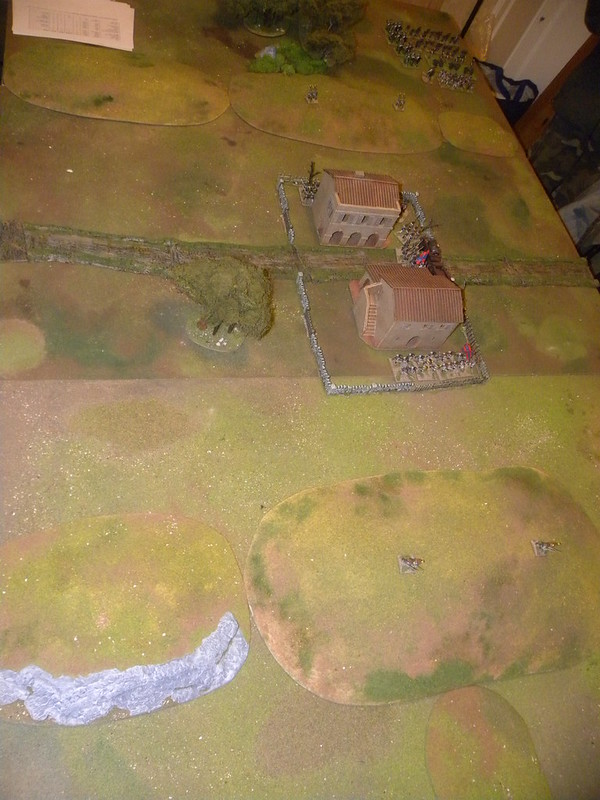
The battlefield. Pole bitwy.
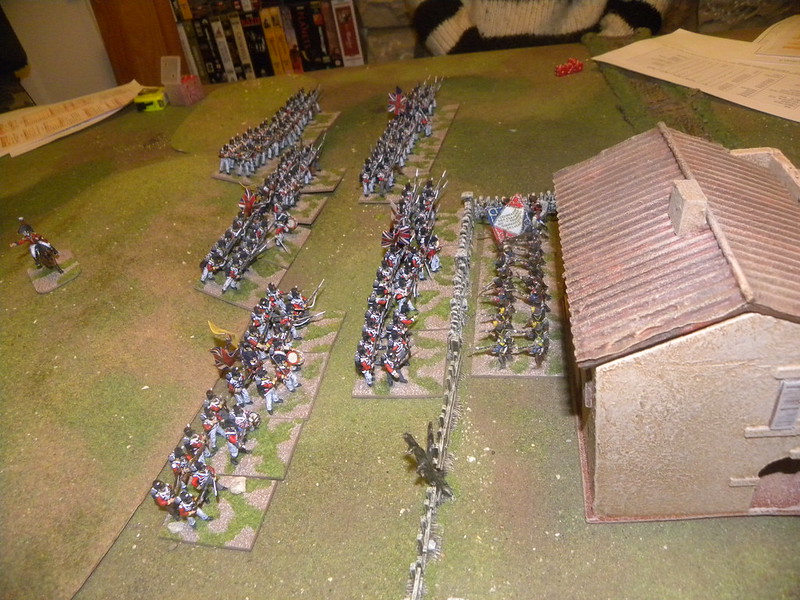
Going back to the game. British unobserved came very close to the
position of the French, who just had a nap. The three British
battalions strengthened with three guns began the siege of the
village. Surprised French very quickly mastered the confusion and
bravely stood up to fight against the overwhelming British forces. At
the same time, Captain Gerard start his long way to bring the
reinforcements. Meanwhile, the fight of the French defensive
positions became more and more intense. To make things worse for the
French shortly on the other side of the valley new British forces
appeared and started storming the the walls surrounding the village.
The first charge was repelled and one of the British battalions
destroyed, but the advantage of attackers became more and more
apparent. Meanwhile, Captain Gerard was not in hurry and slowly
riding west... The situation in the village became not good for the
French, who ware under pressure from the British and had to step back
and let the attackers go between buildings. French also began to bend
under the pressure of the attackers and British victory seemed be
only a matter of time, while Captain Gerard slowly riding in the
direction of the French forces... Meanwhile, in the village, the
British broke the French defenses and slowly began to eliminate
defenders. Captain Gerard finally reached the French forces and,
together with three new infantry battalions, cavalry squadron and
three guns began to march towards the besieged village, but continues
to do it in a very slow manner. The British, who have managed to
eliminate two French battalions were still not able to control the
village. Their cavalry, wisely left in reserve, was suddenly attacked
by French cavalry. The British were forced back and in counter
charge they destroyed French cavalry. It seemed that the French will
lose this battle, but in this moment the game to speed up for me
(most of the game I remained as the passive observer, due to the slow
Captain Gerard movement). Before that, something unexpected happened.
Colin for activation of his guns threw double ones, which caused
blunder. As a result of that was a charge towards the nearest enemy.
Of course, artillery charging the strengthen village looked
ridiculous, but it became the source of numerous comments after the
game. At that time British forces had closed the encirclement and
tried to eliminate the last battalion of French in the village, when
suddenly they were attacked from behind by the French reinforcements
under my command. Fresh forces quickly destroyed some of the
besieging British, defended the village and forced British to
retreat. The fight ended with a decisive victory of the French.
Wracając do gry.
Brytyjczycy niezauważeni podeszli bardzo blisko do pozycji
francuskich, którzy oddawali się drzemce. Trzy brytyjskie bataliony
wzmocnione baterią trzech dział rozpoczęły oblężenie wsi.
Zaskoczeni Francuzi bardzo szybko opanowali zamieszanie i dzielnie
stanęli do walki z przeważającymi siłami brytyjskimi. W tym też
czasie Kapitan Gerard wyruszył w swoja długą drogę w celu
ściągnięcia posiłków. Tymczasem walka o francuskie pozycje
obronne była coraz bardziej zażarta. Na domiar złego dla Francuzów
wkrótce po drugiej stronie doliny pojawiły się nowe siły
brytyjskie i rozpoczęły szturm murów okalających wioskę.
Pierwsza szarża została odparta i jeden z brytyjskich batalionów
zniszczony, ale przewaga atakujących stawała się coraz bardziej
widoczna. A tymczasem Kapitan Gerard, nie spiesząc się zanadto
jechał po posiłki... Sytuacja w wiosce stawała się powoli
niedobra dla Francuzów, którzy pod naporem Brytyjczyków musieli
cofnąć się i pozwolić atakującym wejść pomiędzy zabudowania.
Francuzi zaczęli tez uginać się pod naporem atakujących i
zwycięstwo brytyjskie zdawało się już tylko kwestią czasu, gdy
tymczasem Kapitan Gerard spokojnie podróżował sobie w kierunku sił
francuskich... Tymczasem we wiosce Brytyjczycy przełamali linie
obronne Francuzów i powoli rozpoczęli eliminowanie obrońców.
Kapitan Gerard w końcu dotarł do sił francuskich i wraz z trzema
nowymi batalionami piechoty, trzema działami i szwadronem kawalerii
rozpoczął marsz w kierunku oblężonej wioski, jednak dalej
wykonywał to w bardzo powolnym tempie. Brytyjczycy, którzy zdążyli
wyeliminować już dwa francuskie bataliony, dalej nie byli w stanie
opanować wioski. Ich kawaleria przezornie zostawiona w odwodzie
została nagle zaatakowana przez kawalerię francuską. Brytyjczycy
zostali zmuszeni do wycofania się i w kontr szarży zniszczyli
francuską kawalerię. Wydawało się że Francuzi bitwę tą
przegrają, jednak w tym momencie gra dla mnie przybrała
przyspieszenia (przez większość gry pozostawałem jej biernym
obserwatorem, ze względu na powolnego Kapitana Gerarda). Zanim
jednak to się stało wydarzyło się coś niespodziewanego. Colin na
aktywację swoich armat wyrzucił dublet jedynek, co powoduje tzw
„blunder” w jej wyniku został zmuszony do wykonania
nieoczekiwanej szarży w kierunku najbliższego przeciwnika.
Oczywiście szarża artylerii na umocnienia wioski wyglądał
komicznie, ale stała się ona źródłem licznych komentarzy już po
samej grze. W tym właśnie czasie siły brytyjskie zamknęły
pierścień okrążenia i próbowały wyeliminować ostatni batalion
francuski w wiosce, gdy nagle od tyłu zostali zaatakowani przez
francuskie posiłki pod moim dowództwem. Świerze siły szybko
rozprawiły się z oblegającymi Brytyjczykami i obroniły wioskę
oraz zmusiły Brytyjczyków do odwrotu. Walka zakończyła się
zdecydowanym zwycięstwem francuskim.
British atacking the village. Brytyjczycy szturmują wioskę.
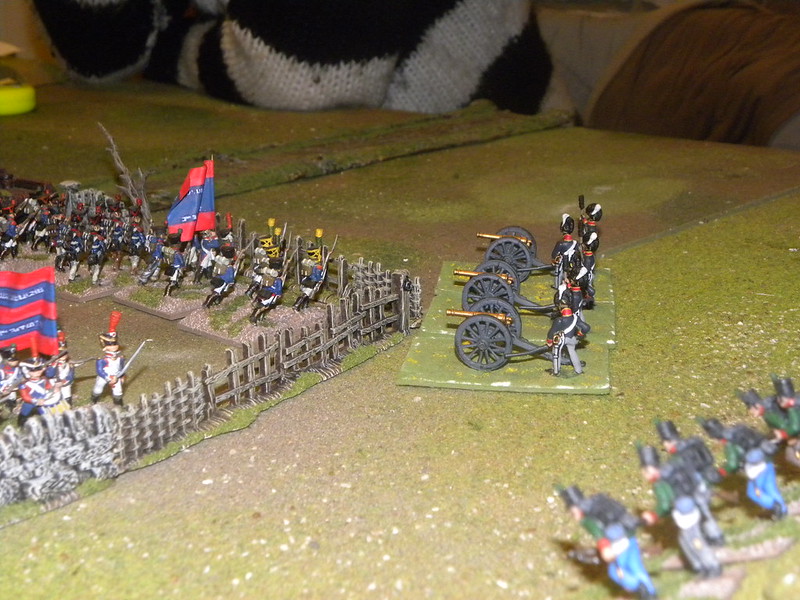
The charge of the cannons. Szarża artylerii.
Decisive French attack. Decydujący atak francuski.
For more pictures from the game, visit my flickr:
Po więcej zdjęć z gry, zapraszam na mojego flickr'a:
Prace nad 24 Pułkiem Ułanów trwają. Czołgi otrzymały już bazowe kolory. Reszta prac w ten weekend i jak wszystko pójdzie zgodnie z planem trzon pułku będzie gotowy do prezentacji w niedzielę wieczorem.
Works on24thUhlansRegimentare in progress.Tankshave already receivedbasiccolors.The rest of theworkthis weekend andif all goesaccording to theplan,the core ofthe regimentwill be ready forpresentationon Sundayevening.
Last Thursday
in SESWC we decided to refresh the Triumph And Tragedy rules.
For this purpose Colin Jack prepared a scenario placed during the
Russo-Japanese War. All figures and most of the terrains comes from
the Colin's collection. Bill Gilchrist led the Japanese, while I was
commanding the Russians. I chose it therefore that during this war,
many Poles served in the Russian army, including many officers who
later on became generals of Second Polish Republic army.
W zeszły czwartek w
SESWC postanowiliśmy odświeżyć sobie zasady Triumph And
Tragedy. W tym celu Colin Jack przygotował scenariusz
rozgrywający się podczas wojny rosyjsko-japońskiej. Wszystkie
figurki, jak i większość terenów pochodzą z kolekcji Colina.
Japończykami dowodził Bill Gilchrist, ja natomiast dowodziłem
Rosjanami. Wybrałem to z tego powodu, że w tej wojnie w armii
rosyjskiej służyło wielu Polaków, w tym wielu późniejszych
generałów armii Drugiej Rzeczypospolitej
The battlefield. Pole bitwy.
Usually
scenarios prepared by Colin contain a some surprices for players and
so it was this time. Both of us, Bill and I, had to divide our forces
into three parts, on troops on tables A, B and C. When we did that,
we learned that the battle will be fought on the table C, and troops
from other tables will be arriving during next turns, 1-6 for units
from table B and 7-12 for units from table A. Luckily for me on that
table I had the most numerous units, but also the weakest in terms of
level of experience. My task was to stop the march of the Japanese
and prevent them from crossing the river. Detailed army lists and
operational plans, can be found on the Bill's blog. (click here)
Scenariusze
przygotowywane przez Colina zazwyczaj zawierają w sobie pewną
niespodziankę dla graczy i tak było w tym przypadku. Oboje z
Bill'em musieliśmy podzielić nasze siły na trzy części, na siły
znajdujące się na stołach A, B i C. Gdy tego dokonaliśmy
dowiedzieliśmy się, że walka będzie toczona na stole C, a
oddziały z innych stołów będą nadchodziły w ciągu następnych
tur, 1-6 dla stołu B i 7-12 dla stołu A. Na moje szczęście na
stole C miałem najliczniejsze oddziały, ale jednocześnie
najsłabsze jeżeli chodzi o poziom doświadczenia. Moim zadaniem
było zatrzymanie pochodu Japończyków i uniemożliwienie im
przeprawy przez rzekę. Szczegółowe rozpiski armii i plany
operacyjne, znajdziecie na blogu Bill'a. (kliknij tutaj)
The fight
started with my fast move towards the river and the village, to take
most suitable defensive positions. Being aware of the shortcomings of
my troops, I had to use my numerical superiority, and as soon as
possible to eliminate the as much as possible Japanese units. For
this purpose I decided to create one from all available to me units,
a great line of infantry, which with fire of their rifles would be
block the ford, whilst the cavalry will be eliminate any Japanese
survivirs in melees. Artillery was supposed to support all my units.
Japanese as the first, used their Chinese mercenaries. The first of
them attacked from the flank on my Cossack but it failed and thus
Japanese lost their first unit. Then the Japanese infantry began
gaining the ford, but there came under fire of the Russian infantry.
Japanese losses were growing, while the Russians took better
positions to the defense. Arrived Japanese artillery unlimbered very
quickly and began to shoot an effective fire on the approaching
Russian reinforcements, effectively disturbing my plan on my right
flank. Meanwhile, the Russian unit defending the ford incur severe
losses, and when it seemed that it will be lost soon, he the second
unit of Chinese mercenaries attacked them and once again the Russians
were victorious. At that time, the Japanese cross the river with the
whole infantry unit, while the Russians finished the preparation for
the defense. Due to the time, we had to finish our game, which at
this point remains unresolved...
Walka rozpoczęła się
od mojego szybkiego ruchu w kierunku rzeki i leżącej nad nią wsi,
by zająć jak najdogodniejsze pozycje obronne. Mając świadomość
niedostatków moich oddziałów, musiałem wykorzystać moją
przewagę liczebną i w jak najkrótszym czasie eliminować jednostki
japońskie. W tym celu postanowiłem utworzyć jedna wielką linię z
całej dostępnej mi piechoty, która ogniem swoich strzelb blokowała
by bród, a kawaleria miała stanowić siłę przełamującą i w
walce wręcz miała eliminować niedobitki. Artyleria miała za
zadanie wspierania ogniem, zagrożonych przełamaniem jednostek.
Japończycy jako pierwsze do walki rzucili oddziały najemników
chińskich. Atak z flanki pierwszego z nich na moich Kozaków,
zakończył się niepowodzeniem i w ten sposób Japończycy stracili
pierwszy oddział. Następnie japońska piechota rozpoczęła
zdobywanie brodu, jednak tu dostała się pod celny ogień rosyjskiej
piechoty. Straty japońskie rosły, natomiast Rosjanie zajmowali
dogodne pozycje do obrony. Przybyła artyleria japońska, szybko się
rozstawiła i rozpoczęła skuteczny ogień w kierunku nadciągających
rosyjskich posiłków, skutecznie przeszkadzając mi w wykonaniu
mojego planu na mojej prawej flance. Tymczasem rosyjski oddział
broniący brodu ponosił coraz dotkliwsze straty i gdy wydawało się,
ze już niedługo zostanie zniesiony, zaatakował go drugi oddział
najemników chińskich i znów górą byli Rosjanie. W tym właśnie
czasie Japończykom udało się w całości przeprawić oddział
piechoty, natomiast Rosjanie kończyli przygotowywanie linii obrony.
Ze względu na czas, musieliśmy zakończyć naszą grę, która w
tym momencie pozostawała nierozstrzygnięta...
Japanese ready to cross the river. Japończycy gotowi by przekroczyć rzekę.
Russian positions. Pozycje rosyjskie.
First charge of the day. Pierwsza szarża dnia.
Second charge of the day. Druga szarża dnia.
Positions at the end of the game. Pozycje na zakończenie gry.
Next probably will be the Very British Civil War.
Następna prawdopodobnie będzie Brytyjska Wojna Domowa.
I received an email from Colin about the game we tested on Thursday and wanted to share it with you.
The game seemed to play much better on the day than it did in the
test, not sure why as I really made very few changes. Everyone seemed
to like it and indeed it took first prize in the Participation section.
Bill and I probably ran about eight games with very different results.
The guy that wrote the rules was there and I had a long chat with him -
he seemed to like what we were doing with them and offered support if
we wanted to do it again.
I just want to say that the game and the table were both prepared to the highest level, and you truly deserved the prize. Well done, guys!
Właśnie otrzymałem maila od Colina dotyczący gry, którą testowaliśmy w czwartek i postanowiłem się z Wami podzielić jego treścią.
Gra rozgrywana była znacznie płynniej niż wtedy podczas testów, nie jestem pewien czemu dokonałem tych kilku zmian. Wszyscy wyglądali, że gra im się podobała i w sumie zajęła pierwsze miejsce wśród gier, w których widzowie mogli wziąć udział. Bill i ja poprowadziliśmy około ośmiu gier z bardzo różnymi rezultatami. Człowiek, który napisał te zasady był tam i długo z nim rozmawiałem o tym - wydawał się, że bardzo mu się podoba mu się to co zrobiliśmy z jego przepisami i zaoferował pomoc, jeśli byśmy chcieli zrobić to znowu.
Chcę tylko dodać, że zarówno gra jak i stół (szkoda, że nie widziałem jego finalnego wyglądu) były przygotowane z zachowaniem najwyższych standardów i szczerze zasłużyliście na nagrodę. Bardzo dobra robota!!!